.jpg)
From a news release issued by Kohl's Department Stores:
MENOMONEE FALLS, Wis. -- Kohl’s Department Stores (NYSE:KSS) today announced that the company will expand its solar program by nearly 25 percent in 2012, installing solar panels at approximately 30 additional Kohl’s locations. While some of the new solar sites will be in states such as California, Connecticut and Maryland where Kohl’s already has a solar presence, additional sites will be located in new solar states for Kohl’s, including Massachusetts, New York and Ohio.
On average, the solar panels will supply 20 to 50 percent of each store’s energy. Construction of the solar panel arrays on the first phase of stores began this spring. Once the installations are complete by the end of 2012, Kohl’s expects to have more than 150 solar locations across 13 states.
Showing posts with label Solar. Show all posts
Showing posts with label Solar. Show all posts
Friday, July 6, 2012

Thursday, June 23, 2011
State’s Hostility Toward Renewables Escalates; “Leaders” Lag Citizenry on Wind Support
Two articles from Catching Wind, a newsletter published by RENEW Wisconsin with funding from a grant from the U.S. Department of Energy:
State’s Hostility Toward Renewables Escalates
At the urging of Wisconsin utilities, several lawmakers have introduced a bill to allow a renewable energy credit (REC) to be banked indefinitely. If adopted, this measure (AB146) would constitute the most devastating legislative assault yet on the state’s renewable energy marketplace, which is already reeling from the suspension of the statewide wind siting rule this March and the loosening of renewable energy definitions to allow Wisconsin utilities to count electricity generated from large Canadian hydro projects toward their renewable energy requirements.
“Leaders” Lag Citizenry on Wind Support
Public support for wind energy development has held strong against the attacks launched by Governor Walker and the Legislature’s new Republican majority, according to a poll conducted between April 11 and April 18 by the St. Norbert College Survey Center for Wisconsin Public Radio.
Asked whether Wisconsin should "increase, decrease or continue with the same amount" of energy supply from various sources, 77% favored increasing wind power, the highest of any option (60% favored increasing hydropower, 54% biomass, 39% natural gas, 27% nuclear, and 19% coal).
State’s Hostility Toward Renewables Escalates
At the urging of Wisconsin utilities, several lawmakers have introduced a bill to allow a renewable energy credit (REC) to be banked indefinitely. If adopted, this measure (AB146) would constitute the most devastating legislative assault yet on the state’s renewable energy marketplace, which is already reeling from the suspension of the statewide wind siting rule this March and the loosening of renewable energy definitions to allow Wisconsin utilities to count electricity generated from large Canadian hydro projects toward their renewable energy requirements.
“Leaders” Lag Citizenry on Wind Support
Public support for wind energy development has held strong against the attacks launched by Governor Walker and the Legislature’s new Republican majority, according to a poll conducted between April 11 and April 18 by the St. Norbert College Survey Center for Wisconsin Public Radio.
Asked whether Wisconsin should "increase, decrease or continue with the same amount" of energy supply from various sources, 77% favored increasing wind power, the highest of any option (60% favored increasing hydropower, 54% biomass, 39% natural gas, 27% nuclear, and 19% coal).
Monday, June 6, 2011
Now online: Wisconsin Renewable Quarterly
The Wisconsin Renewable Quarterly, the newsletter of RENEW Wisconsin, features these article:
Siting Rule Suspension Rocks Wind Industry
In a move that sent shock waves through the wind industry in Wisconsin, a joint legislative panel voted on March 1 to suspend the wind siting rule promulgated by the Public Service Commission in December 2010.
Community Biogas Project Fires Up
Home to 400 dairy farms, Dane County recently dedicated a community-scale manure-to-methane generating system designed to reduce nutrient runoff into the Yahara Lakes.
Insty Prints: Mpower ChaMpion
But if I can help other businesses make some of the harder choices by being more vocal, then I’m willing to help.
Manitoba Hydro: A Washout?
On behalf of our members and the many businesses and individuals who support the continued expansion of Wisconsin’s renewable energy marketplace, RENEW Wisconsin is here to express opposition to AB 114 (and its companion SB 81), and urges the Legislature not to pass this bill.
Verona Firm Begins Work on “Epic” PV
With the commissioning of its 1,300-module solar electric canopy spanning its parking deck, Epic Systems joins an elite group of Wisconsin companies embracing on-site energy capture to reduce their dependence on fossil fuels. At 360 kilowatts (kW), Epic’s new photovoltaic system is the largest solar array in Dane County and the third largest in Wisconsin.
Calendar of Renewable and Energy Efficiency Events
June 17-19, 2001 The Energy Fair. Custer, WI. The nation’s premier sustainable energy education event. Three days of workshops, demonstrations, and exhibits highlighting renewable energy and sustainable living. For details see www.midwestrenew.org.
July 8-10, 2011 EcoFair360. Elkhorn, WI. Join hundreds of exhibitors and presenters and thousands of attendees who will Make Green Happen for three days of education, exploration and inspiration. For details see www.ecofair360.org.
July 16, 2011 Western Wisconsin Sustainability Fair. Menomonie, WI, Dunn County Fair Grounds. Exhibitors from business, government, and non-profi t groups, speakers, workshops, music, energy effi cient vehicles, a photo contest, and a tour of the Cedar Falls Dam. See http://sustainabledunn.org for more information.
July 30, 2011 8th Annual Kickapoo Country Fair. LaFarge, WI. The Midwest’s Largest Organic Food and Sustainability Festival. Food, music, bike and farm tours, cooking demonstrations, theater, kids’ activities, dancing. More information at www.kickappoocountryfair.org.
October 1, 2011 Solar Tour of Homes and Businesses. All across Wisconsin. Owners open their doors to let people see how renewable energy is practical, reliable, and affordable in today’s economy. The homes and businesses often include other energy efficiency and renewable technologies. For details see http://nationalsolartour.org.
October 26, 2011 Wisconsin’s Solar Decade Conference. Milwaukee, WI. Now in its seventh year, the Wisconsin
Solar Decade Conference is your opportunity to see fi rsthand the latest developments in the world of solar energy. For details see www.solardecade.com.
Siting Rule Suspension Rocks Wind Industry
In a move that sent shock waves through the wind industry in Wisconsin, a joint legislative panel voted on March 1 to suspend the wind siting rule promulgated by the Public Service Commission in December 2010.
Community Biogas Project Fires Up
Home to 400 dairy farms, Dane County recently dedicated a community-scale manure-to-methane generating system designed to reduce nutrient runoff into the Yahara Lakes.
Insty Prints: Mpower ChaMpion
But if I can help other businesses make some of the harder choices by being more vocal, then I’m willing to help.
Manitoba Hydro: A Washout?
On behalf of our members and the many businesses and individuals who support the continued expansion of Wisconsin’s renewable energy marketplace, RENEW Wisconsin is here to express opposition to AB 114 (and its companion SB 81), and urges the Legislature not to pass this bill.
Verona Firm Begins Work on “Epic” PV
With the commissioning of its 1,300-module solar electric canopy spanning its parking deck, Epic Systems joins an elite group of Wisconsin companies embracing on-site energy capture to reduce their dependence on fossil fuels. At 360 kilowatts (kW), Epic’s new photovoltaic system is the largest solar array in Dane County and the third largest in Wisconsin.
Calendar of Renewable and Energy Efficiency Events
June 17-19, 2001 The Energy Fair. Custer, WI. The nation’s premier sustainable energy education event. Three days of workshops, demonstrations, and exhibits highlighting renewable energy and sustainable living. For details see www.midwestrenew.org.
July 8-10, 2011 EcoFair360. Elkhorn, WI. Join hundreds of exhibitors and presenters and thousands of attendees who will Make Green Happen for three days of education, exploration and inspiration. For details see www.ecofair360.org.
July 16, 2011 Western Wisconsin Sustainability Fair. Menomonie, WI, Dunn County Fair Grounds. Exhibitors from business, government, and non-profi t groups, speakers, workshops, music, energy effi cient vehicles, a photo contest, and a tour of the Cedar Falls Dam. See http://sustainabledunn.org for more information.
July 30, 2011 8th Annual Kickapoo Country Fair. LaFarge, WI. The Midwest’s Largest Organic Food and Sustainability Festival. Food, music, bike and farm tours, cooking demonstrations, theater, kids’ activities, dancing. More information at www.kickappoocountryfair.org.
October 1, 2011 Solar Tour of Homes and Businesses. All across Wisconsin. Owners open their doors to let people see how renewable energy is practical, reliable, and affordable in today’s economy. The homes and businesses often include other energy efficiency and renewable technologies. For details see http://nationalsolartour.org.
October 26, 2011 Wisconsin’s Solar Decade Conference. Milwaukee, WI. Now in its seventh year, the Wisconsin
Solar Decade Conference is your opportunity to see fi rsthand the latest developments in the world of solar energy. For details see www.solardecade.com.
Thursday, May 26, 2011
Energy groups oppose bill to undermine Wisconsin's renewable energy commitment
From statements issued by three groups in opposition to Assembly Bill 146:
"Clearly, this bill is a drastic step in the wrong direction for our state. The Wisconsin Energy Business Association therefore opposes this attack on renewable energy in our state." - Wisconsin Energy Business Association. Full statement.
We strongly recommend that this bill not be approved as it solves no known problem in Wisconsin and seeks only to roll-back policies on renewable energy that have served the state well and are otherwise benefitting Wisconsin residents with cleaner air and lower prices for electricity. - Wind on the Wires. Full statement.
Fresh attack on Wisconsin voters’ desire for a renewable energy standard would kill wind projects and sap state’s economy, say wind energy advocates - American Wind Energy Association. Full statement.
"Clearly, this bill is a drastic step in the wrong direction for our state. The Wisconsin Energy Business Association therefore opposes this attack on renewable energy in our state." - Wisconsin Energy Business Association. Full statement.
We strongly recommend that this bill not be approved as it solves no known problem in Wisconsin and seeks only to roll-back policies on renewable energy that have served the state well and are otherwise benefitting Wisconsin residents with cleaner air and lower prices for electricity. - Wind on the Wires. Full statement.
Fresh attack on Wisconsin voters’ desire for a renewable energy standard would kill wind projects and sap state’s economy, say wind energy advocates - American Wind Energy Association. Full statement.
Tuesday, April 19, 2011
Earth Day Economics: A Green and Prosperous Future
From an article in the Shepherd Express by Doug Booth, a retired Marquette University economics professor, a founder of the Driftless Area Land Conservancy, and author of The Coming Good Boom: Creating Prosperity for All and Saving the Environment Through Compact Living:
The astounding success of the first Earth Day on April 22, 1970, under the tutelage of a true Wisconsin hero, Sen. Gaylord Nelson, marked the coming of age of the environmental movement in this country. Environmental victories in the 1970s included the passage of such landmark legislation as the Clean Air, Clean Water and Endangered Species acts. Earth Day ushered in a new environmental era, and today the quality of our lives is much improved for it.
Unfortunately, our work remains unfinished.
Our single greatest environmental threat today is global warming brought to us by the burning of fossil fuels to power our cars, heat our homes, grow our food and fabricate and operate all our wonderful consumer gadgets. Scientists tell us that greenhouse gases from fossil fuels act like a "tea cozy" around the Earth, bringing forth dangerous environmental harms reported in the news on a daily basis—a shrinking polar ice cap, rising sea levels, more powerful storms, droughts and wildfires.
Reducing Fossil Fuel Consumption
Bringing global warming to a halt can be accomplished with a simple act—freeing ourselves from the environmental tyranny of fossil fuels. Some will say this is easier said than done, but doing so will bring on what I call a "good boom" that will lift all our boats. The "good boom" will be an economic expansion created through compact urban living, clean energy, more grassland and less corn, green cuisine, letting forests grow old and more. It will also help us address global warming. . . .
Wind and Solar Are the Future's Power Sources
Necessary to moving beyond fossil fuels is a switch to truly clean sources of renewable energy. Notwithstanding Gov. Scott Walker's attempt to bring wind energy to a screeching halt with onerous regulations, both wind and sun are the primary energy sources of the future. For example, California lawmakers recently approved a rule requiring utilities to derive one-third of their power from renewable energy sources within 10 years. As we do more of anything in our economy, its cost inevitably falls. This is happening already for both wind and solar energy. The Great Plains is on track to becoming the Saudi Arabia of wind energy, and throughout the Midwest industrial belt, old factories are quickly being refitted to produce wind generators and solar panels. Despite the naysayers, the wind and solar energy revolution is under way, bringing forth an abundance of new jobs—windsmiths, solar panel installers, weatherization specialists, solar engineers, wind and solar equipment fabricators and, here in Milwaukee, urban farmers.
To be sure, the fossil fuel industry will resist going quietly and will defend to the death its right to pollute the atmosphere without cost. Eventually, the industry will lose this battle and will pay the public piper through some form of a tax on greenhouse gas emissions.
The astounding success of the first Earth Day on April 22, 1970, under the tutelage of a true Wisconsin hero, Sen. Gaylord Nelson, marked the coming of age of the environmental movement in this country. Environmental victories in the 1970s included the passage of such landmark legislation as the Clean Air, Clean Water and Endangered Species acts. Earth Day ushered in a new environmental era, and today the quality of our lives is much improved for it.
Unfortunately, our work remains unfinished.
Our single greatest environmental threat today is global warming brought to us by the burning of fossil fuels to power our cars, heat our homes, grow our food and fabricate and operate all our wonderful consumer gadgets. Scientists tell us that greenhouse gases from fossil fuels act like a "tea cozy" around the Earth, bringing forth dangerous environmental harms reported in the news on a daily basis—a shrinking polar ice cap, rising sea levels, more powerful storms, droughts and wildfires.
Reducing Fossil Fuel Consumption
Bringing global warming to a halt can be accomplished with a simple act—freeing ourselves from the environmental tyranny of fossil fuels. Some will say this is easier said than done, but doing so will bring on what I call a "good boom" that will lift all our boats. The "good boom" will be an economic expansion created through compact urban living, clean energy, more grassland and less corn, green cuisine, letting forests grow old and more. It will also help us address global warming. . . .
Wind and Solar Are the Future's Power Sources
Necessary to moving beyond fossil fuels is a switch to truly clean sources of renewable energy. Notwithstanding Gov. Scott Walker's attempt to bring wind energy to a screeching halt with onerous regulations, both wind and sun are the primary energy sources of the future. For example, California lawmakers recently approved a rule requiring utilities to derive one-third of their power from renewable energy sources within 10 years. As we do more of anything in our economy, its cost inevitably falls. This is happening already for both wind and solar energy. The Great Plains is on track to becoming the Saudi Arabia of wind energy, and throughout the Midwest industrial belt, old factories are quickly being refitted to produce wind generators and solar panels. Despite the naysayers, the wind and solar energy revolution is under way, bringing forth an abundance of new jobs—windsmiths, solar panel installers, weatherization specialists, solar engineers, wind and solar equipment fabricators and, here in Milwaukee, urban farmers.
To be sure, the fossil fuel industry will resist going quietly and will defend to the death its right to pollute the atmosphere without cost. Eventually, the industry will lose this battle and will pay the public piper through some form of a tax on greenhouse gas emissions.
Wednesday, April 13, 2011
The nuclear option: Safety concerns are only one big reason wind and solar better
From a commentary by Mark Z. Jacobson in the New York Daily News:
The powerful earthquake and tsunami that caused reactors at Japan's Fukushima nuclear power plant to shut down - releasing radiation and endangering workers and evacuees - have many Americans asking whether nuclear energy is worth the investment and risk.
I say not. In fact, it should not have taken a disaster of this kind to move us decisively away from nuclear and toward safe, clean, renewable energy. . . .
If the world's energy needs were converted to electricity for all purposes - and nuclear supplied such energy - 15,800 large nuclear reactors, one installed every day for the next 43 years, would be needed. The installation of even 5% of these would nearly double the current number of reactors, giving many more countries the potential to develop weapons. If only one weapon were used in a city, it could kill 1 to 16 million people.
***
Why do we need nuclear energy when we have safer, cleaner options that can provide greater power for a much longer period and at lower cost to society? These better options are called WWS, for "wind, water and sunlight." The chance of catastrophe caused by nature or terrorists acting on wind or solar, in particular, is zero.
During their lifetimes, WWS technologies emit no pollution - whereas nuclear does, since continuous energy is needed to mine, transport and refine uranium and reactors require much longer to permit and install than do WWS technologies. Overall, nuclear emits 9 to 25 times more air pollution and carbon dioxide than does wind per unit energy generated.
***
Some argue that nuclear is more reliable than WWS systems. This is not true. A nuclear reactor affects a larger fraction of the grid when it fails than does a wind turbine. The average maintenance downtime of modern wind turbines on land is 2%. That of France's 59 reactors is 21.5%, with about half due to scheduled maintenance.
The powerful earthquake and tsunami that caused reactors at Japan's Fukushima nuclear power plant to shut down - releasing radiation and endangering workers and evacuees - have many Americans asking whether nuclear energy is worth the investment and risk.
I say not. In fact, it should not have taken a disaster of this kind to move us decisively away from nuclear and toward safe, clean, renewable energy. . . .
If the world's energy needs were converted to electricity for all purposes - and nuclear supplied such energy - 15,800 large nuclear reactors, one installed every day for the next 43 years, would be needed. The installation of even 5% of these would nearly double the current number of reactors, giving many more countries the potential to develop weapons. If only one weapon were used in a city, it could kill 1 to 16 million people.
***
Why do we need nuclear energy when we have safer, cleaner options that can provide greater power for a much longer period and at lower cost to society? These better options are called WWS, for "wind, water and sunlight." The chance of catastrophe caused by nature or terrorists acting on wind or solar, in particular, is zero.
During their lifetimes, WWS technologies emit no pollution - whereas nuclear does, since continuous energy is needed to mine, transport and refine uranium and reactors require much longer to permit and install than do WWS technologies. Overall, nuclear emits 9 to 25 times more air pollution and carbon dioxide than does wind per unit energy generated.
***
Some argue that nuclear is more reliable than WWS systems. This is not true. A nuclear reactor affects a larger fraction of the grid when it fails than does a wind turbine. The average maintenance downtime of modern wind turbines on land is 2%. That of France's 59 reactors is 21.5%, with about half due to scheduled maintenance.
Tuesday, March 15, 2011
Focus offers competitive grants to businesses for large renewable energy projects
From a news release issued by Focus on Energy:
Completed proposals due April 30, 2011
MADISON, Wis. (March 11, 2011) – Today, Focus on Energy, Wisconsin utilities’ statewide program for energy efficiency and renewable energy, announced that businesses can compete for incentives for large renewable energy systems. The Large Renewable Energy System Competitive Incentives allow Wisconsin businesses and organizations to apply for funds to help implement large renewable energy systems.
Businesses can receive an incentive of up to 30 percent of the project costs to complete a renewable energy project that is well-researched, documented, and justified. Eligible, large-scale renewable energy systems may include: solar electric, solar hot-water, wind electric, biomass energy, and anaerobic digestion (biogas).
“Renewable energy technology offers businesses deeper energy cost savings after energy efficiency measures are implemented.” said Ken Williams, Focus on Energy’s business programs director. “Focus’ large renewable energy competitive incentives help businesses defray some of the upfront investment cost of a renewable energy system, resulting in a quicker payback."
Any type of business, school, government entity, agribusiness, and apartments/condo facilities can apply for a Focus competitive incentive. The application and details are available online at focusonenergy.com/competitive_incentives. Applications are due by April 30, 2011.
Completed proposals due April 30, 2011
MADISON, Wis. (March 11, 2011) – Today, Focus on Energy, Wisconsin utilities’ statewide program for energy efficiency and renewable energy, announced that businesses can compete for incentives for large renewable energy systems. The Large Renewable Energy System Competitive Incentives allow Wisconsin businesses and organizations to apply for funds to help implement large renewable energy systems.
Businesses can receive an incentive of up to 30 percent of the project costs to complete a renewable energy project that is well-researched, documented, and justified. Eligible, large-scale renewable energy systems may include: solar electric, solar hot-water, wind electric, biomass energy, and anaerobic digestion (biogas).
“Renewable energy technology offers businesses deeper energy cost savings after energy efficiency measures are implemented.” said Ken Williams, Focus on Energy’s business programs director. “Focus’ large renewable energy competitive incentives help businesses defray some of the upfront investment cost of a renewable energy system, resulting in a quicker payback."
Any type of business, school, government entity, agribusiness, and apartments/condo facilities can apply for a Focus competitive incentive. The application and details are available online at focusonenergy.com/competitive_incentives. Applications are due by April 30, 2011.
Friday, December 17, 2010
Grant program passed, thousands of renewable energy jobs saved
From an article in Renewable Energy World:
Washington, D.C. -- In typical fashion, the U.S. Congress passed a suite of last-minute tax laws last night, including an extension of the Treasury Grant Program (TGP) for renewable energy project developers.
Trade groups in Washington have been pushing hard for an extension of the program, which provides a cash payment of up to 30% of equipment costs in place of the Investment Tax Credit. The grant program was responsible for a large portion of the renewable energy projects built throughout the U.S. in 2010. Originally passed as part of the 2009 stimulus package, the TGP was supposed to expire at the end of December.
Because there are still a limited number of financial institutions able to finance projects by taking advantage of tax credits, the TGP has opened up new sources of capital for project developers. According to the Solar Energy Industries Association (SEIA), the grant program spurred over 1,100 solar projects and $18 billion dollars of investment in 2010.
“This program has successfully created thousands of jobs and opportunity in all 50 states for construction workers, electricians, plumbers, contractors that have struggled in this harsh economic climate,” said SEIA President Rhone Resch in a statement.
While the wind industry saw a significant drop in installations compared to 2009, the grant program helped keep thousands of MW on the table for 2010 and 2011. American Wind Energy Association CEO Denise Bode projected a loss of tens of thousands of wind jobs in 2011 without an extension of the TGP.
Washington, D.C. -- In typical fashion, the U.S. Congress passed a suite of last-minute tax laws last night, including an extension of the Treasury Grant Program (TGP) for renewable energy project developers.
Trade groups in Washington have been pushing hard for an extension of the program, which provides a cash payment of up to 30% of equipment costs in place of the Investment Tax Credit. The grant program was responsible for a large portion of the renewable energy projects built throughout the U.S. in 2010. Originally passed as part of the 2009 stimulus package, the TGP was supposed to expire at the end of December.
Because there are still a limited number of financial institutions able to finance projects by taking advantage of tax credits, the TGP has opened up new sources of capital for project developers. According to the Solar Energy Industries Association (SEIA), the grant program spurred over 1,100 solar projects and $18 billion dollars of investment in 2010.
“This program has successfully created thousands of jobs and opportunity in all 50 states for construction workers, electricians, plumbers, contractors that have struggled in this harsh economic climate,” said SEIA President Rhone Resch in a statement.
While the wind industry saw a significant drop in installations compared to 2009, the grant program helped keep thousands of MW on the table for 2010 and 2011. American Wind Energy Association CEO Denise Bode projected a loss of tens of thousands of wind jobs in 2011 without an extension of the TGP.
Friday, October 15, 2010
WPS sister company invests heavily in solar electricity
From a blog post by Tom Content on JSonline:
Wisconsin-based Integrys Energy Services will invest $90 million in new solar power projects around the country under an agreement through a partnership with Duke Energy of North Carolina and Smart Energy Capital of New York.
Under the partnership, Duke and Integrys said they will each invest $90 million over the next two years in distributed solar projects, which will be operated and maintained by the two energy companies.
Smart Energy Capital, a finance and investment company focused exclusively on the North American solar electric industry, will develop the projects and arrange financing under the partnership.
Integrys has been actively pursuing solar projects since 2008.
“We have invested more than $65 million in 20 different distributed generation solar projects across the U.S. with a combined capacity of more than 10 megawatts,” said Joel Jansen, managing director at Integrys Energy Services, in a statement.
Duke and Integrys said they believe most growth in the solar market over the next several years will involve commercial-scale applications on building roofs and ground-mounted systems. . . .
Integrys Energy Services is based south of Green Bay and is a national energy company that markets natural gas as well as electricity in states like Illinois that have opened up their power markets to competition. It is a sister company of Wisconsin Public Service Corp., the electric and natural gas utility serving northeastern Wisconsin.
Wisconsin-based Integrys Energy Services will invest $90 million in new solar power projects around the country under an agreement through a partnership with Duke Energy of North Carolina and Smart Energy Capital of New York.
Under the partnership, Duke and Integrys said they will each invest $90 million over the next two years in distributed solar projects, which will be operated and maintained by the two energy companies.
Smart Energy Capital, a finance and investment company focused exclusively on the North American solar electric industry, will develop the projects and arrange financing under the partnership.
Integrys has been actively pursuing solar projects since 2008.
“We have invested more than $65 million in 20 different distributed generation solar projects across the U.S. with a combined capacity of more than 10 megawatts,” said Joel Jansen, managing director at Integrys Energy Services, in a statement.
Duke and Integrys said they believe most growth in the solar market over the next several years will involve commercial-scale applications on building roofs and ground-mounted systems. . . .
Integrys Energy Services is based south of Green Bay and is a national energy company that markets natural gas as well as electricity in states like Illinois that have opened up their power markets to competition. It is a sister company of Wisconsin Public Service Corp., the electric and natural gas utility serving northeastern Wisconsin.
Thursday, October 7, 2010
Jimmy Carter redeemed: White House to tap sun for heating water and some electricity
From an Associated Press article by Dina Cappiello in the Milwaukee Journal Sentinel:
WASHINGTON (AP) -- Solar power is coming to President Barack Obama's house.
The most famous residence in America, which has already boosted its green credentials by planting a garden, plans to install solar panels atop the White House's living quarters. The solar panels are to be installed by spring 2011, and will heat water for the first family and supply some electricity.
Energy Secretary Steven Chu announced the plans Tuesday in Washington at a conference of local, state, academic and nonprofit leaders aimed at identifying how the federal government can improve its environmental performance.
Former Presidents Jimmy Carter and George W. Bush both tapped the sun during their days in the White House. Carter in the late 1970s spent $30,000 on a solar water-heating system for West Wing offices. Bush's solar systems powered a maintenance building and some of the mansion, and heated water for the pool.
Obama, who has championed renewable energy, has been under increasing pressure by the solar industry and environmental activists to lead by example by installing solar at 1600 Pennsylvania Avenue, something White House officials said has been under consideration since he first took office.
The decision perhaps has more import now after legislation to reduce global warming pollution died in the Senate, despite the White House's support. Obama has vowed to try again on a smaller scale.
Last month, global warming activists with 350.org carried one of Carter's solar panels - which were removed in 1986 - from Unity College in Maine to Washington to urge Obama to put solar panels on his roof. It was part of a global campaign to persuade world leaders to install solar on their homes. After a meeting with White House officials, they left Washington without a commitment.
Bill McKibben, the founder of the 350.org group, said Tuesday the administration did the right thing.
WASHINGTON (AP) -- Solar power is coming to President Barack Obama's house.
The most famous residence in America, which has already boosted its green credentials by planting a garden, plans to install solar panels atop the White House's living quarters. The solar panels are to be installed by spring 2011, and will heat water for the first family and supply some electricity.
Energy Secretary Steven Chu announced the plans Tuesday in Washington at a conference of local, state, academic and nonprofit leaders aimed at identifying how the federal government can improve its environmental performance.
Former Presidents Jimmy Carter and George W. Bush both tapped the sun during their days in the White House. Carter in the late 1970s spent $30,000 on a solar water-heating system for West Wing offices. Bush's solar systems powered a maintenance building and some of the mansion, and heated water for the pool.
Obama, who has championed renewable energy, has been under increasing pressure by the solar industry and environmental activists to lead by example by installing solar at 1600 Pennsylvania Avenue, something White House officials said has been under consideration since he first took office.
The decision perhaps has more import now after legislation to reduce global warming pollution died in the Senate, despite the White House's support. Obama has vowed to try again on a smaller scale.
Last month, global warming activists with 350.org carried one of Carter's solar panels - which were removed in 1986 - from Unity College in Maine to Washington to urge Obama to put solar panels on his roof. It was part of a global campaign to persuade world leaders to install solar on their homes. After a meeting with White House officials, they left Washington without a commitment.
Bill McKibben, the founder of the 350.org group, said Tuesday the administration did the right thing.
Tuesday, October 5, 2010
Solar power proves steady investment for Janesville man
From an article by Frank Schultz in the Janesville Press Gazette:
JANESVILLE — So you want to invest.
Stock? Too wobbly.
Interest at the banks? Scant.
A rural Janesville man has found an investment that appears to work in any economy: the sun.
The sun, which is not expected to burn out for billions of years, spills massive amounts of energy onto the Earth every day. It also puts cash into Chuck Niles’ pocket.
Niles, a retired General Motors worker, said he’s been thinking about solar power for 25 years. He got serious about it three years ago when he learned that improvements in solar technology have reduced the cost per watt considerably.
Then he heard about government programs that provide huge discounts in startup costs.
Here’s how Niles does the math:
The 90 panels on the roof of Niles’ pole barn and nearby shed on Murray Road south of Janesville cost $130,410, installation included.
A federal program known as Section 1603 of the Recovery Act paid him $39,600. The state Focus on Energy program paid him $32,603.
Niles uses about $35 worth of electricity a month in the barn. The rest goes to Alliant Energy, which pays him monthly. The checks vary with sunshine, but Niles estimates conservatively that the checks will average around $440 a month.
In the meantime, Niles is also getting a federal income-tax break from the depreciation on his investment.
When all the costs and benefits are accounted for, Niles figures his payback period is just five years. He figures his return on investment is about 12 percent.
JANESVILLE — So you want to invest.
Stock? Too wobbly.
Interest at the banks? Scant.
A rural Janesville man has found an investment that appears to work in any economy: the sun.
The sun, which is not expected to burn out for billions of years, spills massive amounts of energy onto the Earth every day. It also puts cash into Chuck Niles’ pocket.
Niles, a retired General Motors worker, said he’s been thinking about solar power for 25 years. He got serious about it three years ago when he learned that improvements in solar technology have reduced the cost per watt considerably.
Then he heard about government programs that provide huge discounts in startup costs.
Here’s how Niles does the math:
The 90 panels on the roof of Niles’ pole barn and nearby shed on Murray Road south of Janesville cost $130,410, installation included.
A federal program known as Section 1603 of the Recovery Act paid him $39,600. The state Focus on Energy program paid him $32,603.
Niles uses about $35 worth of electricity a month in the barn. The rest goes to Alliant Energy, which pays him monthly. The checks vary with sunshine, but Niles estimates conservatively that the checks will average around $440 a month.
In the meantime, Niles is also getting a federal income-tax break from the depreciation on his investment.
When all the costs and benefits are accounted for, Niles figures his payback period is just five years. He figures his return on investment is about 12 percent.
Tuesday, September 28, 2010
Open house of solar homes and businesses, October 2
Visit homes and businesses around the state to see renewable energy up close. In addition to showcasing solar and wind power, houses will feature energy efficiency, green building techniques, and sustainable living ideas. Speak with home and business owners and find out how renewable energy works for them. Self selected driving tours will be available throughout the state.
Tours are FREE and open to the public between 10 am and 4 pm. To view the locations and details of the sites in your area, go to http://www.the-mrea.org/solartour.php.
The Wisconsin solar tours are part of the National Solar Tours of the American Solar Energy Society that are happening in states across the country on the same day.
Tours are FREE and open to the public between 10 am and 4 pm. To view the locations and details of the sites in your area, go to http://www.the-mrea.org/solartour.php.
The Wisconsin solar tours are part of the National Solar Tours of the American Solar Energy Society that are happening in states across the country on the same day.
Wednesday, June 30, 2010
20 MW solar energy farm proposed in Jefferson
From an article by Ryan Whisner in the Jefferson Daily Union:
JEFFERSON - A proposal to build the second-largest solar-generation farm in the United States was presented to City of Jefferson officials Wednesday night.
Green States Energy Inc. of Deerfield Beach, Fla., unveiled plans to build a solar energy farm on 100 acres of the city's north industrial park that would generate approximately 20 megawatts of electricity.
Jefferson Sun One would have approximately 100,000 individual solar panel modules on the 100-acre parcel. The site - just north of the former Brigg & Stratton plant - would generate approximately 3.5 million kilowatt hours per year, equivalent to generating sufficient electricity for about 3,500 homes. An interconnectivity agreement with Jefferson Utilities and WPPI is intended.
"This is a big deal if it can be brought to fruition and can be built," said David Jenkins of the Wisconsin Office of Energy Independence.
Currently, he noted, Wisconsin has approximately 6.5 megawatts of installed solar capacity. Only two cities in the state are labeled by the U.S. Department of Energy as solar cities.
"Overnight, if this project were built, the City of Jefferson would have three times as much solar energy as there is in the entire state," Jenkins said. "As far as I'm concerned, if you had 20 megawatts of power here, you would be a solar city."
Approximately five to six weeks ago, Jefferson city officials were approached by representatives from Green States Energy about locating the solar energy farm in Jefferson. Green States representatives presented its proposal Wednesday to a joint session of the Jefferson Common Council, Jefferson Plan Commission and Jefferson Redevelopment Authority.
"It is an opportunity for us to not only provide a lot of good jobs in the construction phase and also the operational stage, but it is also an opportunity for the City of Jefferson to create an identity of being a nationwide leader in renewable energy," Mayor Dale Oppermann said. "We have the task, the challenge and the opportunity to reinvent the economy of Jefferson and the surrounding area."
He said Green States Inc. is offering the city the chance to get involved with state-of-the-art technology and create an identity for the city as being clean and green.
Green States Energy Inc. chief executive officer Jeffrey Lord described the company as a group of people who have come together under a common principle.
"The planet and the people on it will be better off if we can start using less fossil fuels to get the energy we need," Lord said, citing the company's mission.
JEFFERSON - A proposal to build the second-largest solar-generation farm in the United States was presented to City of Jefferson officials Wednesday night.
Green States Energy Inc. of Deerfield Beach, Fla., unveiled plans to build a solar energy farm on 100 acres of the city's north industrial park that would generate approximately 20 megawatts of electricity.
Jefferson Sun One would have approximately 100,000 individual solar panel modules on the 100-acre parcel. The site - just north of the former Brigg & Stratton plant - would generate approximately 3.5 million kilowatt hours per year, equivalent to generating sufficient electricity for about 3,500 homes. An interconnectivity agreement with Jefferson Utilities and WPPI is intended.
"This is a big deal if it can be brought to fruition and can be built," said David Jenkins of the Wisconsin Office of Energy Independence.
Currently, he noted, Wisconsin has approximately 6.5 megawatts of installed solar capacity. Only two cities in the state are labeled by the U.S. Department of Energy as solar cities.
"Overnight, if this project were built, the City of Jefferson would have three times as much solar energy as there is in the entire state," Jenkins said. "As far as I'm concerned, if you had 20 megawatts of power here, you would be a solar city."
Approximately five to six weeks ago, Jefferson city officials were approached by representatives from Green States Energy about locating the solar energy farm in Jefferson. Green States representatives presented its proposal Wednesday to a joint session of the Jefferson Common Council, Jefferson Plan Commission and Jefferson Redevelopment Authority.
"It is an opportunity for us to not only provide a lot of good jobs in the construction phase and also the operational stage, but it is also an opportunity for the City of Jefferson to create an identity of being a nationwide leader in renewable energy," Mayor Dale Oppermann said. "We have the task, the challenge and the opportunity to reinvent the economy of Jefferson and the surrounding area."
He said Green States Inc. is offering the city the chance to get involved with state-of-the-art technology and create an identity for the city as being clean and green.
Green States Energy Inc. chief executive officer Jeffrey Lord described the company as a group of people who have come together under a common principle.
"The planet and the people on it will be better off if we can start using less fossil fuels to get the energy we need," Lord said, citing the company's mission.
Tuesday, June 1, 2010
We Energy project under way to propose of 12.5 MW of solar power generation
An announcement by We Energies:
We Energies has a commitment to propose the development of approximately 12.5 MW of solar power generation. This solar commitment entails 5 MW by Jan. 1, 2013, and the remaining 7.5 MW by Jan. 1, 2015. With the development and permitting phase of the Glacier Hills Wind Park completed, Andy Hesselbach, wind farm project manager, will be taking on the added responsibility of developing a plan to comply with this commitment.
To assist in these planning and development efforts, Carl Siegrist, senior project strategist - Regulatory Affairs and Policy, has been assigned to work under Hesselbach’s direction. Siegrist serves on the board of directors of two national solar organizations, has been involved with the Public Service Commission of Wisconsin solar task force, and has a network of contacts in all aspects of the solar business and Wisconsin's clean energy advocacy community.
Hesselbach and Siegrist will collaborate with a broad range of regulatory, legal, finance, business planning, engineering and operations personnel during 2010 to develop a plan for compliance with this commitment.
We Energies has a commitment to propose the development of approximately 12.5 MW of solar power generation. This solar commitment entails 5 MW by Jan. 1, 2013, and the remaining 7.5 MW by Jan. 1, 2015. With the development and permitting phase of the Glacier Hills Wind Park completed, Andy Hesselbach, wind farm project manager, will be taking on the added responsibility of developing a plan to comply with this commitment.
To assist in these planning and development efforts, Carl Siegrist, senior project strategist - Regulatory Affairs and Policy, has been assigned to work under Hesselbach’s direction. Siegrist serves on the board of directors of two national solar organizations, has been involved with the Public Service Commission of Wisconsin solar task force, and has a network of contacts in all aspects of the solar business and Wisconsin's clean energy advocacy community.
Hesselbach and Siegrist will collaborate with a broad range of regulatory, legal, finance, business planning, engineering and operations personnel during 2010 to develop a plan for compliance with this commitment.
Friday, January 8, 2010
Doyle launches Clean Energy Jobs initiative
From a news release issued by Governor Jim Doyle:
MADISON – Governor Jim Doyle today was joined by business leaders, labor, legislators and environmental organizations as he launched the Clean Energy Jobs Act, a landmark legislative package to accelerate the state’s green economy and create jobs. New industry-recognized research shows the package will directly create at least 15,000 green jobs in Wisconsin by 2025.
“Addressing climate change is not just an environmental issue, it’s about creating green jobs,” Governor Doyle said.
“The Clean Energy Jobs Act offers new standards to help accelerate Wisconsin’s green economy. I am calling on the Legislature to update renewable portfolio standards to generate 25 percent of our fuel from renewable sources by 2025 and set a realistic goal of a 2 percent annual reduction in energy consumption by 2015.”
The Clean Energy Jobs Act, State Senate Bill 450 and State Assembly Bill 649, implements the recommendations of Governor Doyle’s Global Warming Task Force to address climate change and grow the state’s green economy through several key measures:
• Enhanced renewable portfolio standards – A new 20 percent standard would be set for 2020 and a 25 percent standard would be set for 2025. The current 10 percent standard would be accelerated from 2015 to 2013. By advancing our current renewable portfolio standards, and setting new standards, we will ensure more of our energy dollars stay in the state, creating thousands of jobs for Wisconsin families in fields like construction, manufacturing, and agriculture.
• Enhanced energy efficiency and conservation efforts – Graduated statewide electricity savings goals would be set, leading up to a 2 percent reduction by 2015 and annual reductions thereafter. The cheapest way to lower carbon emissions is through energy conservation. By setting achievable conservation goals, this bill will help reduce energy costs in businesses and homes across the state.
A comprehensive economic assessment of the Clean Energy Jobs Act found that the package would directly create at least 15,000 green jobs in Wisconsin by 2025. More than 1,800 jobs would be created in the first year alone. The assessment also found that between 800 and 1,800 construction jobs would be created each year from 2011-2025, and more than 2,000 manufacturing jobs would be created once the laws are fully implemented.
Michael Vickerman, RENEW Wisconsin’s executive director said:
Wisconsin's existing 10% Renewable Energy Standard has driven significant investment in rural, forestry and agriculture markets by encouraging the construction of large wind, biogas, biomass and solar projects. Increasing the Renewable Energy Standard to 25% in 2025 would continue to generate more of the lucrative payments to landowners and biofuel / biomass providers as well as create more jobs constructing and maintaining the additional projects are built to meet the new standards.
The bills also include three of the proposals backed by the Homegrown Renewable Energy Campaign:
• Renewable Energy Buyback Rates, also called an Advanced Renewable Tariffs, would set utility payments for small renewable energy producers who want to "feed energy" into the electric grid, enabling farmers and rural businesses to help Wisconsin become more energy independent with biopower, wind and solar.
• The Biomass Crop Reserve Program would award contracts to farmers to plant native perennial plants, which the farmer can then sell for bioenergy production, helping to solve the chicken-and-egg problem of jumpstarting the homegrown fuels market.
• A Low-Carbon Fuel Standard would be a market-based approach to promoting the cleanest, low-carbon fuels for Wisconsin, and would put Wisconsin in a position to capture the rapidly-developing clean energy market by using Wisconsin's abundant natural resources like switchgrass.
Statements of support for the legislation came from Customers First!, WPPI Energy, CREWE, Clean Wisconsin, ACRE, MEUW, Sierra Club, and others.
MADISON – Governor Jim Doyle today was joined by business leaders, labor, legislators and environmental organizations as he launched the Clean Energy Jobs Act, a landmark legislative package to accelerate the state’s green economy and create jobs. New industry-recognized research shows the package will directly create at least 15,000 green jobs in Wisconsin by 2025.
“Addressing climate change is not just an environmental issue, it’s about creating green jobs,” Governor Doyle said.
“The Clean Energy Jobs Act offers new standards to help accelerate Wisconsin’s green economy. I am calling on the Legislature to update renewable portfolio standards to generate 25 percent of our fuel from renewable sources by 2025 and set a realistic goal of a 2 percent annual reduction in energy consumption by 2015.”
The Clean Energy Jobs Act, State Senate Bill 450 and State Assembly Bill 649, implements the recommendations of Governor Doyle’s Global Warming Task Force to address climate change and grow the state’s green economy through several key measures:
• Enhanced renewable portfolio standards – A new 20 percent standard would be set for 2020 and a 25 percent standard would be set for 2025. The current 10 percent standard would be accelerated from 2015 to 2013. By advancing our current renewable portfolio standards, and setting new standards, we will ensure more of our energy dollars stay in the state, creating thousands of jobs for Wisconsin families in fields like construction, manufacturing, and agriculture.
• Enhanced energy efficiency and conservation efforts – Graduated statewide electricity savings goals would be set, leading up to a 2 percent reduction by 2015 and annual reductions thereafter. The cheapest way to lower carbon emissions is through energy conservation. By setting achievable conservation goals, this bill will help reduce energy costs in businesses and homes across the state.
A comprehensive economic assessment of the Clean Energy Jobs Act found that the package would directly create at least 15,000 green jobs in Wisconsin by 2025. More than 1,800 jobs would be created in the first year alone. The assessment also found that between 800 and 1,800 construction jobs would be created each year from 2011-2025, and more than 2,000 manufacturing jobs would be created once the laws are fully implemented.
Michael Vickerman, RENEW Wisconsin’s executive director said:
Wisconsin's existing 10% Renewable Energy Standard has driven significant investment in rural, forestry and agriculture markets by encouraging the construction of large wind, biogas, biomass and solar projects. Increasing the Renewable Energy Standard to 25% in 2025 would continue to generate more of the lucrative payments to landowners and biofuel / biomass providers as well as create more jobs constructing and maintaining the additional projects are built to meet the new standards.
The bills also include three of the proposals backed by the Homegrown Renewable Energy Campaign:
• Renewable Energy Buyback Rates, also called an Advanced Renewable Tariffs, would set utility payments for small renewable energy producers who want to "feed energy" into the electric grid, enabling farmers and rural businesses to help Wisconsin become more energy independent with biopower, wind and solar.
• The Biomass Crop Reserve Program would award contracts to farmers to plant native perennial plants, which the farmer can then sell for bioenergy production, helping to solve the chicken-and-egg problem of jumpstarting the homegrown fuels market.
• A Low-Carbon Fuel Standard would be a market-based approach to promoting the cleanest, low-carbon fuels for Wisconsin, and would put Wisconsin in a position to capture the rapidly-developing clean energy market by using Wisconsin's abundant natural resources like switchgrass.
Statements of support for the legislation came from Customers First!, WPPI Energy, CREWE, Clean Wisconsin, ACRE, MEUW, Sierra Club, and others.
Monday, December 7, 2009
Solar panels rise to Capitol heights
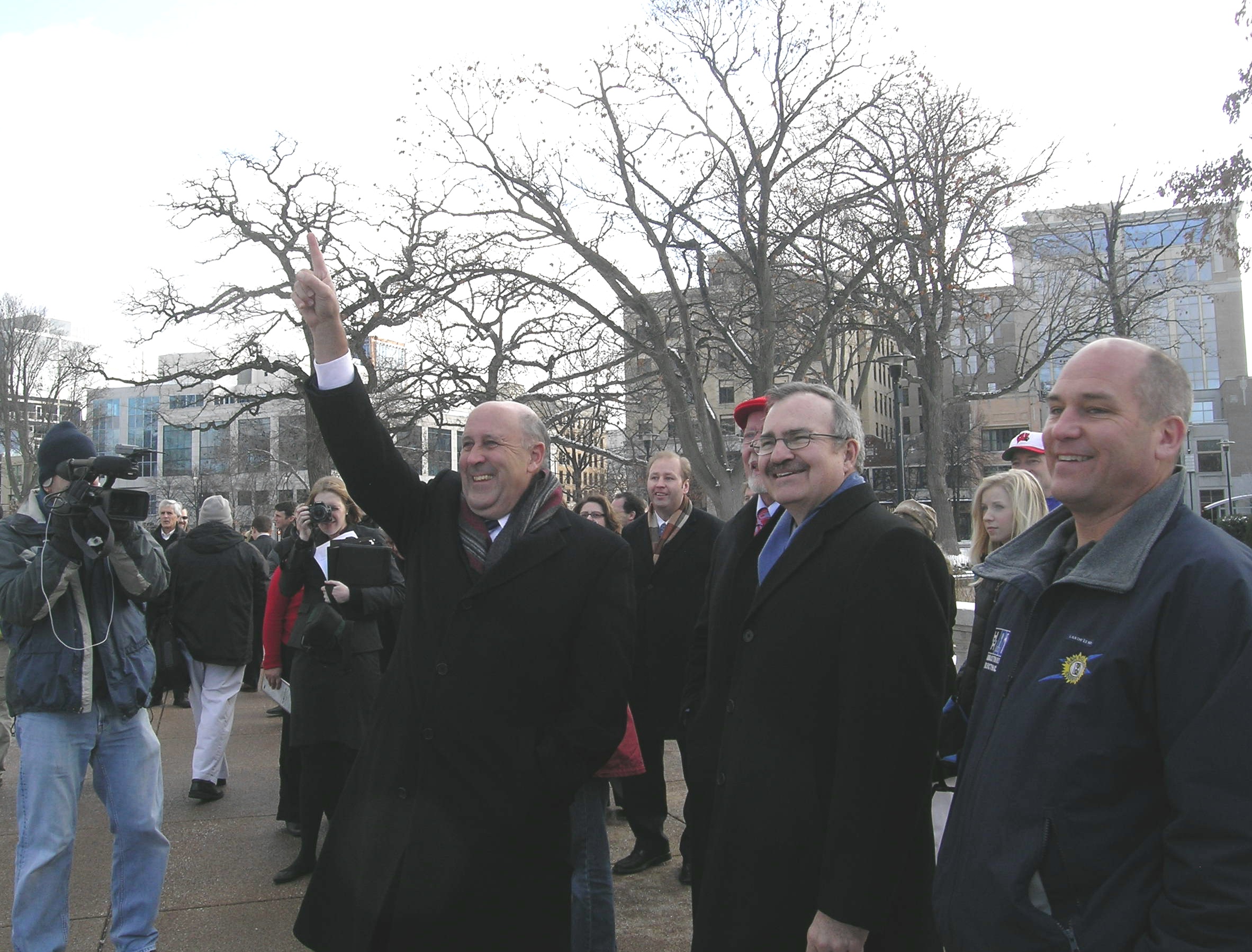
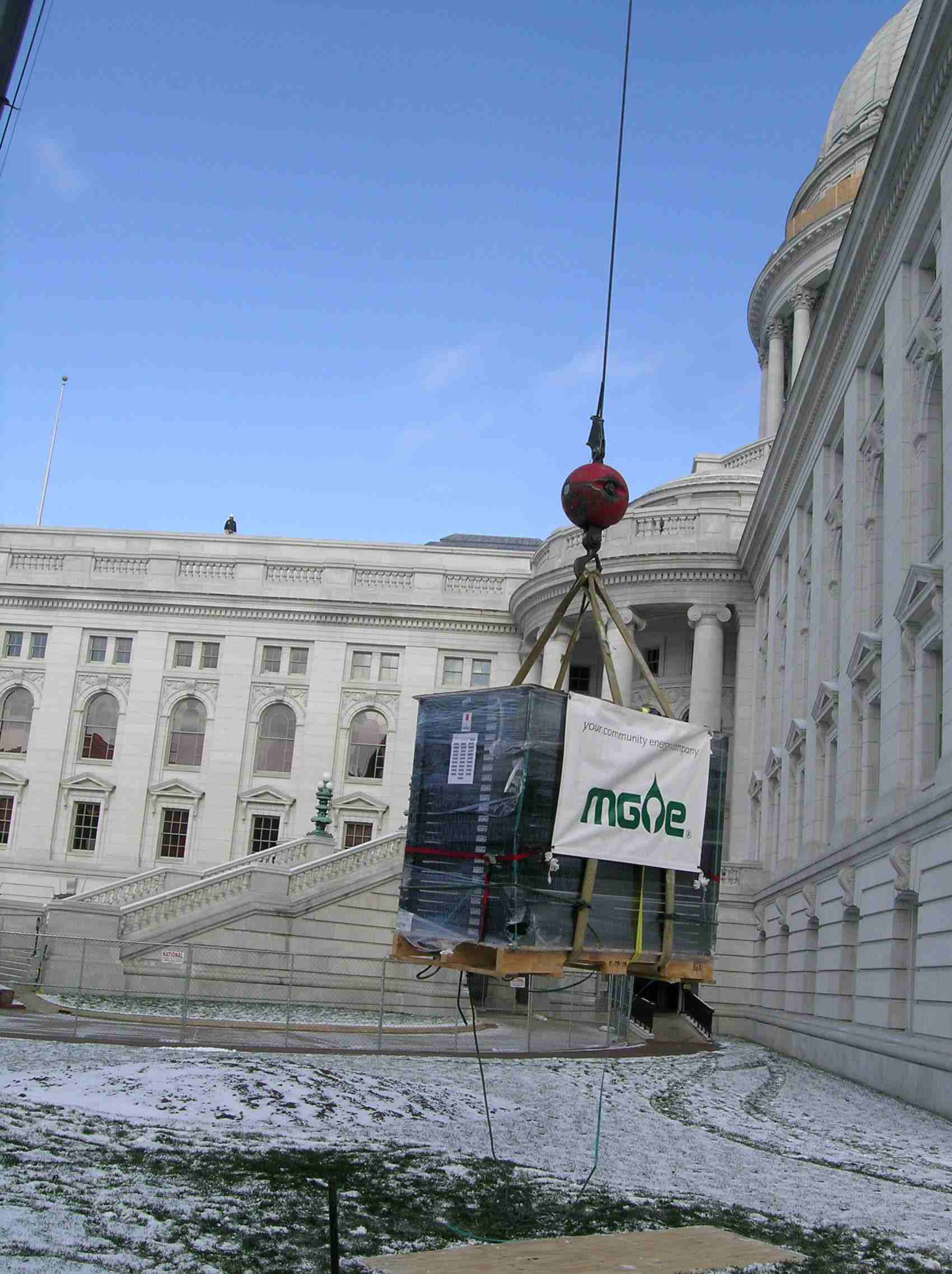 Governor Jim Doyle signals a crane operator to lift the first pallet of solar panels (right) for installation on the West Wing of the State Capitol. Madison Gas and Electric (MGE) President Gary (middle) and Chris Collins (right), a representative of the installer H&H Solar, joined in the liftoff.
 The 48 solar panels in the final installation will cover 9,600 square feet on the Capitol roof and produce about 11,700 kilowatt hours of electricity a year, slightly more than a typical Wisconsin home would use annually.The system will be owned and maintained by MGE, which is fully funding the $78,000 project.
Monday, November 16, 2009
Solar energy field remains strong in Wisconsin
From an article by Tom Content in the Milwaukee Journal Sentinel:
Given our climate, Wisconsin would never be mistaken for the best solar state in the country.
But among non-Sun Belt states, the state is staking a claim in providing power from the sun.
Except for California and Texas, Wisconsin is the only state with two cities - Milwaukee and Madison - in the national Solar America Cities program.
A $19.6 million project for Roundy's Corp. in Oconomowoc would become the largest solar power project in the Midwest, if it gets $8.8 million in federal stimulus funding.
And the state has more certified solar installers per capita than nearly every state in the country, according to Tehri Parker, executive director of the Midwest Renewable Energy Association. Even with the recession, the number of solar installations is expanding - and so is training for solar-contracting jobs, Parker said.
On a recent weekend in Milwaukee, trainees from Wyoming, Virginia and Missouri were on a rooftop in Milwaukee's central city installing solar panels on a Habitat for Humanity home.
Habitat is partnering with We Energies and the Midwest Renewable Energy Association to provide much-needed training for solar technicians - a job that's expected to be in high demand given the growth trajectory that solar enjoys.
John Price, a firefighter with the Brookfield Fire Department, is looking to switch careers into a greener line of work.
He's getting trained in solar installation, working on installing solar panels at Habitat for Humanity homes in Milwaukee, and forming a Waukesha business, Access Solar, with his sons.
He was leading an installation at a Habitat house a few weeks back and learned his students hailed from across the country.
"It's people who've been laid off, or are people who are in their 40s who are changing careers or laid off and looking for something else," said Price, 50.
Small fraction
Solar represents a fraction of the energy supply puzzle. If the state's energy supply in 2007 were a 500-piece jigsaw puzzle, coal would account for more than 300 pieces, and renewable energy would account for about 20 pieces. All the solar power in the state wouldn't add up to a piece.
But the growth rate for solar has been something to behold, even as advocates concede the numbers are small in total.
"It's been a remarkable year," said Niels Wolter, who heads solar programs at the state Focus on Energy program. "We're projecting out 73% growth over last year. Before that it was growing at about 80% per year since 2002. So it's slowed down a little bit in the growth rate, but it's still a booming market. . . ."
Even with all these projects and announcements, some renewable energy advocates say the growth rate will slow considerably in 2010 because electric utilities no longer are offering extra incentives to give the solar market a boost.
We Energies had a generous solar buyback rate in place two years ago, and replaced it with a different program this year. That program is fully subscribed, and no more applications are being accepted.
Michael Vickerman, executive director of the advocacy group Renew Wisconsin, said the expiration of those incentives is unfortunate. He's urging the state to move aggressively to require utilities to offer generous buyback rates.
"We are clearly the leading state in the Midwest, but that momentum is in danger of dissipating," said Vickerman. "Because what really attracts customers and would-be system owners is the buyback rate."
And developers of large solar projects aren't coming to Wisconsin, said green-energy consultant Brett Hulsey, because Wisconsin hasn't followed states such as California and New Jersey in adopting tax credits to bring down the price of solar projects.
Utilities say that the incentives are being subsidized by other utility customers. Other incentives are still available, including a 30% federal tax credit and rebates from Focus on Energy, said We Energies spokesman Brian Manthey.
In addition, the prices for solar panels themselves have dropped by 15% in recent months, shortening the number of years it would take to pay back the investment in solar from about 23 years to about 20 years, depending on the project.
Given our climate, Wisconsin would never be mistaken for the best solar state in the country.
But among non-Sun Belt states, the state is staking a claim in providing power from the sun.
Except for California and Texas, Wisconsin is the only state with two cities - Milwaukee and Madison - in the national Solar America Cities program.
A $19.6 million project for Roundy's Corp. in Oconomowoc would become the largest solar power project in the Midwest, if it gets $8.8 million in federal stimulus funding.
And the state has more certified solar installers per capita than nearly every state in the country, according to Tehri Parker, executive director of the Midwest Renewable Energy Association. Even with the recession, the number of solar installations is expanding - and so is training for solar-contracting jobs, Parker said.
On a recent weekend in Milwaukee, trainees from Wyoming, Virginia and Missouri were on a rooftop in Milwaukee's central city installing solar panels on a Habitat for Humanity home.
Habitat is partnering with We Energies and the Midwest Renewable Energy Association to provide much-needed training for solar technicians - a job that's expected to be in high demand given the growth trajectory that solar enjoys.
John Price, a firefighter with the Brookfield Fire Department, is looking to switch careers into a greener line of work.
He's getting trained in solar installation, working on installing solar panels at Habitat for Humanity homes in Milwaukee, and forming a Waukesha business, Access Solar, with his sons.
He was leading an installation at a Habitat house a few weeks back and learned his students hailed from across the country.
"It's people who've been laid off, or are people who are in their 40s who are changing careers or laid off and looking for something else," said Price, 50.
Small fraction
Solar represents a fraction of the energy supply puzzle. If the state's energy supply in 2007 were a 500-piece jigsaw puzzle, coal would account for more than 300 pieces, and renewable energy would account for about 20 pieces. All the solar power in the state wouldn't add up to a piece.
But the growth rate for solar has been something to behold, even as advocates concede the numbers are small in total.
"It's been a remarkable year," said Niels Wolter, who heads solar programs at the state Focus on Energy program. "We're projecting out 73% growth over last year. Before that it was growing at about 80% per year since 2002. So it's slowed down a little bit in the growth rate, but it's still a booming market. . . ."
Even with all these projects and announcements, some renewable energy advocates say the growth rate will slow considerably in 2010 because electric utilities no longer are offering extra incentives to give the solar market a boost.
We Energies had a generous solar buyback rate in place two years ago, and replaced it with a different program this year. That program is fully subscribed, and no more applications are being accepted.
Michael Vickerman, executive director of the advocacy group Renew Wisconsin, said the expiration of those incentives is unfortunate. He's urging the state to move aggressively to require utilities to offer generous buyback rates.
"We are clearly the leading state in the Midwest, but that momentum is in danger of dissipating," said Vickerman. "Because what really attracts customers and would-be system owners is the buyback rate."
And developers of large solar projects aren't coming to Wisconsin, said green-energy consultant Brett Hulsey, because Wisconsin hasn't followed states such as California and New Jersey in adopting tax credits to bring down the price of solar projects.
Utilities say that the incentives are being subsidized by other utility customers. Other incentives are still available, including a 30% federal tax credit and rebates from Focus on Energy, said We Energies spokesman Brian Manthey.
In addition, the prices for solar panels themselves have dropped by 15% in recent months, shortening the number of years it would take to pay back the investment in solar from about 23 years to about 20 years, depending on the project.
Wednesday, November 4, 2009
Solar Powering Your Community: A Guide for Local Governments
From Solar American Cities in the U.S. Department of Energy:
The U.S. Department of Energy developed this comprehensive resource to assist local governments and stakeholders in building sustainable local solar markets. The guide introduces a range of policy and program options that have been successfully field tested in cities around the country. The guide describes each policy or program, followed by more information on:
•Benefits: Identifies benefits from implementing the policy or program.
•Implementation Tips and Options: Outlines various tips and options for designing and implementing the policy or program.
•Examples: Highlights experiences from communities that have successfully implemented the policy or program.
•Additional References and Resources: Lists additional reports, references, and tools that offer more information on the topic, where applicable.
The U.S. Department of Energy developed this comprehensive resource to assist local governments and stakeholders in building sustainable local solar markets. The guide introduces a range of policy and program options that have been successfully field tested in cities around the country. The guide describes each policy or program, followed by more information on:
•Benefits: Identifies benefits from implementing the policy or program.
•Implementation Tips and Options: Outlines various tips and options for designing and implementing the policy or program.
•Examples: Highlights experiences from communities that have successfully implemented the policy or program.
•Additional References and Resources: Lists additional reports, references, and tools that offer more information on the topic, where applicable.
Thursday, August 20, 2009
Registration opens for Solar Decade Conference, Oct. 2, Milwaukee
From the Web page of the Solar Decade:
Join renowned industry experts as they discuss the benefits of solar energy for your home, business and career!
Now in its fifth year, the Wisconsin Solar Decade Conference is your opportunity to see firsthand the latest developments in the world of solar energy. Register today to hear from top industry experts and attend dozens of exhibits, workshops and panel discussions as you discover the state of the technology, the state of the market and where both will be tomorrow!
•Learn about the latest solar energy applications for your home and business
•Discover opportunities to tap the renewable energy market and expand your business
•Network with fellow builders, contractors, homeowners and business owners
Keynote speakers
Dr. Lawrence L. Kazmerski
Executive Director of Science and Technology Partnerships, National Renewable Energy Laboratory
Dr. Lawrence L. Kazmerski, executive director of science and technology partnerships at the National Renewable Energy Laboratory in Golden, Colorado, is a solar-energy industry veteran who has authored hundreds of journal papers and several books on solar photovoltaics. For his years of research and work, "Kaz" has received recognition both nationally and internationally.
Travis Bradford
Founder and President - Prometheus Institute for Sustainable Development
Travis Bradford is founder and president of the Prometheus Institute for Sustainable Development, a nonprofit organization focused on harnessing the power of the business sector to develop cost-effective and sustainable solutions in technology. In his most recent book, Solar Revolution, Bradford argues that solar energy will become the best and cheapest choice for energy over the next 20 years.
Join renowned industry experts as they discuss the benefits of solar energy for your home, business and career!
Now in its fifth year, the Wisconsin Solar Decade Conference is your opportunity to see firsthand the latest developments in the world of solar energy. Register today to hear from top industry experts and attend dozens of exhibits, workshops and panel discussions as you discover the state of the technology, the state of the market and where both will be tomorrow!
•Learn about the latest solar energy applications for your home and business
•Discover opportunities to tap the renewable energy market and expand your business
•Network with fellow builders, contractors, homeowners and business owners
Keynote speakers
Dr. Lawrence L. Kazmerski
Executive Director of Science and Technology Partnerships, National Renewable Energy Laboratory
Dr. Lawrence L. Kazmerski, executive director of science and technology partnerships at the National Renewable Energy Laboratory in Golden, Colorado, is a solar-energy industry veteran who has authored hundreds of journal papers and several books on solar photovoltaics. For his years of research and work, "Kaz" has received recognition both nationally and internationally.
Travis Bradford
Founder and President - Prometheus Institute for Sustainable Development
Travis Bradford is founder and president of the Prometheus Institute for Sustainable Development, a nonprofit organization focused on harnessing the power of the business sector to develop cost-effective and sustainable solutions in technology. In his most recent book, Solar Revolution, Bradford argues that solar energy will become the best and cheapest choice for energy over the next 20 years.
Tuesday, May 19, 2009
MGE will expand solar program
From a news release issued by Madison Gas and Electric:
Madison, Wis., May 19, 2009 . . . Madison Gas and Electric (MGE) will expand its Clean Power Partners solar energy program by more than three times.
MGE received permission last week from the Public Service Commission of Wisconsin to increase this pilot program from 300 kilowatts to 1 megawatt, said Gary Wolter, chairman, president and CEO, at the 2009 MGE Energy Annual Meeting.
In 2008, the program's capacity was doubled from its original 150 kilowatts. Clean Power Partners is now fully subscribed with a total of 62 solar installations—40 residential and 22 commercial/industrial projects.
Clean Power Partners encourages customers to install solar photovoltaic systems on their homes or businesses and then sell the energy back to MGE for $0.25 per kilowatt-hour. The solar energy is part of MGE's green pricing program—Green Power Tomorrow.
MGE's green pricing program was recently recognized for having the second highest participation rate of all investor-owned utilities in the country by the U.S. Department of Energy's National Renewal Energy Laboratory.
In addition, MGE ranks in the top 1% nationwide in green power sales as a percentage of total retail electricity sold. MGE ranks sixth out of a total of 850 utilities. The company increased wind power capacity by more than 12 times in 2008 as four new wind farms in Wisconsin and Iowa began production.
Madison, Wis., May 19, 2009 . . . Madison Gas and Electric (MGE) will expand its Clean Power Partners solar energy program by more than three times.
MGE received permission last week from the Public Service Commission of Wisconsin to increase this pilot program from 300 kilowatts to 1 megawatt, said Gary Wolter, chairman, president and CEO, at the 2009 MGE Energy Annual Meeting.
In 2008, the program's capacity was doubled from its original 150 kilowatts. Clean Power Partners is now fully subscribed with a total of 62 solar installations—40 residential and 22 commercial/industrial projects.
Clean Power Partners encourages customers to install solar photovoltaic systems on their homes or businesses and then sell the energy back to MGE for $0.25 per kilowatt-hour. The solar energy is part of MGE's green pricing program—Green Power Tomorrow.
MGE's green pricing program was recently recognized for having the second highest participation rate of all investor-owned utilities in the country by the U.S. Department of Energy's National Renewal Energy Laboratory.
In addition, MGE ranks in the top 1% nationwide in green power sales as a percentage of total retail electricity sold. MGE ranks sixth out of a total of 850 utilities. The company increased wind power capacity by more than 12 times in 2008 as four new wind farms in Wisconsin and Iowa began production.
Subscribe to:
Posts (Atom)